Remembering Matthew together: finding connection through grief

St Christopher's C Icon White

In 2025, we spoke to Nina about her experience with St Christopher’s after her husband, Matthew, died in our care. Nina spoke about the bereavement support that she and their two daughters had received through our Candle service.

As we look ahead to our Remembering events, we caught up with Nina again to reflect on the three years since Matthew died.
A young girl and her dad in a restaurant, he has his arm around her and they are smiling at the camera. She has a piece of bread in her hand, a striped top and a hair band with felt flowers on.

Matthew’s memory continues to live on through the everyday moments that remind his family of the person he was.

“It’s often the little things that bring Matthew into our conversations,” Nina explains. “A song will come on, somebody will say something that sounds just like him, or one of the children will do something and someone will say, ‘You’re just like your dad.’ Those moments happen naturally and they keep him very much part of our lives.”

Photographs have become an important way for the family to remember and share stories. “Looking through photos is one of the best ways we remember Matthew,” says Nina. “Every picture has a story attached to it.”

Alongside everyday reminders, milestone dates such as birthdays and anniversaries provide natural opportunities to reflect. “Those special dates are always important, but we’ve also learnt that remembrance doesn’t have to be tied to a particular day,” Nina says. “Sometimes you just need to create a moment for yourself, step away from everything else and allow yourself a bit of time to think about the person you’re missing.”

Following Matthew’s death, the family accessed support through St Christopher’s bereavement services, including family remembrance events and parent support groups.

Nina says, “When you’re grieving, it can feel incredibly isolating. You can be surrounded by friends and family but still feel like nobody really understands what you’re going through. Being in a room with other people who have experienced loss changes that.”

The family remembrance events made a particular impact on both Nina and her children.

“The events create such a safe, loving environment,” she recalls. “Everything is designed with children in mind and it gives them permission to remember their person in a way that feels comfortable for them.”

For the children, one of the most powerful aspects was seeing other young people who had also experienced bereavement.

“I think it was really reassuring for them to see they weren’t the only people of their age going through this,” Nina says. “Grief can make you feel very different from your friends and classmates. Seeing other children and teenagers who understood what it was like helped normalise those feelings.”

Among the most memorable experiences was attending St Christopher’s outdoor remembrance event during the Christmas period.

“Christmas can be one of the hardest times after you’ve lost someone,” Nina says. “There’s such an emphasis on family and togetherness, and it’s impossible not to notice the person who’s missing.”

The remembrance service offered a chance to reflect alongside others facing similar emotions.

“Seeing the lights and the names of loved ones was incredibly moving,” she says. “It created a real sense of community. Looking around, you realised there were so many people there who were remembering someone special too. It made us feel connected and part of something bigger than our loss.” For Nina, the event balanced sadness with hope.

Alongside the remembrance events, the parent and carer support group became an invaluable source of support. “The group is made up of people from all sorts of backgrounds and family situations, but the one thing everyone has in common is that they’ve experienced loss,” Nina says. “That shared understanding creates an immediate bond.”

The group provided both practical help and emotional reassurance. “There have been times when I’ve picked up really useful ideas from other parents, and there have been times when we’ve simply sat and talked about how difficult things can be,” she says. “Sometimes we’ve even found ourselves laughing together. Those moments are just as important.”

Being part of the group helped reduce feelings of isolation and build lasting connections.

“It gives you a sense of community at a time when you can feel very alone,” Nina reflects. “You realise that other people understand the challenges you’re facing and that can make an enormous difference.”

When asked what she would say to someone considering attending a bereavement event or support group, Nina’s advice is simple.

“I would say, ‘Give it a go.’ The thought of attending can feel daunting because grief itself can feel daunting. But you don’t have to know exactly what to say or do. Just turning up is enough.”

Looking back, Nina says the greatest gift has been the feeling of connection.

“Every time we’ve attended, we’ve come away feeling supported,” she says. “We’ve remembered Matthew, we’ve shared stories about him and we’ve spent time with people who truly understand what loss feels like. That sense of connection is incredibly powerful and reminds you that you don’t have to navigate grief on your own.”

Find out more

Actress Linda Murphy Regan donates a specialist bed to St Christopher’s in memory of her late husband, Brian Murphy

A photograph of Linda Murphy Regan and Amanda Mayo on a bed at St Christopher's hospice. There is a small white dog on the bed between them.

Linda and Brian were married for 36 years and, whilst both well-known actors, met on the set of ‘Wife begins at 40’.

When Brian’s health began to decline at the end of 2024, his wife Linda, found herself facing a situation that changed almost overnight. What began as back pain quickly became a series of falls and increasing discomfort. After several A&E visits and an initial suggestion that he may have sprained his spine, Linda arranged a private scan. The results were devastating: extensive bone metastases caused by prostate cancer.

A photograph of Linda Murphy Regan and her husband, Brian. Linda has should length blonde hair and is smiling as she has her arms around Brian.

Within a few days of receiving the diagnosis, they were referred to St Christopher’s hospice. From that moment, Linda says, everything shifted. Linda said: “The hospice team moved quickly to put support in place, Brian wanted to stay at home and they helped that happen. Nurses began visiting three times a day, offering expert care and reassurance at a time when Brian’s condition was deteriorating rapidly.”

One of the most transformative pieces of support was the delivery of a specialist adjustable bed provided by the hospice in Brian’s home. For Linda, this made an enormous difference. Linda said: “The bed eased Brian’s pain, reduced the physical strain, and allowed him to rest with dignity and comfort. The nurses’ compassion left a lasting impression. They took great care when turning Brian to minimise pain, and even ensured his moustache, a signature part of his appearance, was kept neat. “ One nurse recognised Brian from his on-screen work, a moment that brought warmth and connection during a very difficult time.

A photograph of Linda Murphy Regan and her husband, Brian. Linda has should length blonde hair and is smiling as she has her arms around Brian.

Brian died in February 2025, only a few weeks after his diagnosis. In the months that followed, Linda accessed one-to-one bereavement support at St Christopher’s in Orpington. She completed around 10–12 sessions and found the support invaluable in helping her navigate her grief. Linda said: “The woman supporting me was wonderful, I liked her very much.”

Alongside this, Linda continued her longstanding involvement with the Lady Rattlings, a charitable group connected to the entertainment community. As a trustee, she helps coordinate fundraising and equipment donations, a role that would soon take on new meaning. The specialist bed had made such a profound difference to Brian’s final weeks that Linda was determined to ensure someone else could benefit in the same way. She set out to raise funds to purchase a falls bed to donate to St Christopher’s.

A memorial event held at Brian’s church brought together friends, supporters and well-known figures from the entertainment world. With tickets priced around £15–£20 and supported by the The Grand Order of the Lady Ratlings, the event raised thousands of pounds.

The new bed has arrived, and Linda has donated it as a lasting tribute to Brian and in gratitude for the care they received.

On Monday 13 July, Linda visited St Christopher’s hospice with friends Vicky Bailey, Debbie McGee and Vicki Michelle to see the bed and meet some of St Christopher’s clinical team.

A photograph of Debbie McGee, Vicki Michelle, Linda Murphy Regan and two St Christopher's clinical staff, standing behind a bed in a St Christopher's hospice room. They're all looking at the camera and smiling.

The Power of Nursing Through Storytelling

Marie Cooper, Kerene Payne, Eva Paoletti, Sachin Dwivedi and Andrew Adeck 

There is a kind of care that no textbook fully captures. It lives in quiet hospital rooms, in whispered confessions, in hands held through the longest nights.

On International Nurses Day, the Global Palliative Nursing Network (GPNN) brought four nurses to the stage at the Nursing Now Challenge Global Event, and each one told a story that stayed in the room long after they finished speaking.

Storytellers, Story Gatherers, Story Keepers

As a nurse, Kerene is the backbone of South Africa’s community PC team. She spoke first, and she gave the room a framework that felt like something they had always known but never quite named. Palliative nurses, she said, move through three roles and each one matters.

A photograph of Kerene Payne. Kerene has her blonde hair tied back and is smiling for a professional photo - looking directly into the camera and wearing a patterned blouse.

As storytellers, we sit with patients and draw out the words they are afraid to say, their dreams, their fears, their regrets, and we carry those words forward to advocate for them when they can no longer advocate for themselves. As story gatherers, we go deeper still, learning not just the patient’s condition but their whole life: the adventures, the loves, the losses, the memories they want to leave behind. And as story keepers, we become the guardians of the things said only once, in a low voice, in a room where the door is closed. The last wishes. The long-held guilt. The quiet plea for forgiveness. Patients share these things because they know, in the space a nurse creates, they will never be judged. They will only ever be met with love.

Eva has long dark hair covering her shoulders and is wearing a white top and yellow cardigan. Eva is stting on a sofa, smiling widely as she looks into the camera.

The Secret Everyone Already Knew

Eva travelled around the world to write her book, joined us from the UK, and she has come to recognise a particular kind of silence, the silence of a family that has, without words, agreed to pretend. The patient does not mention dying. The family does not acknowledge the truth. Everyone believes they are protecting each other, and everyone grieves quietly and alone.

She remembered the afternoon a man in his fifties, lying in a hospice bed with his wife beside him, simply looked up and asked: “Am I dying?” Eva was trained for this question. But before she could speak, his wife answered. Calmly. Honestly. With so much love, the room filled. Yes, she said. And I will be right here until the end. He wept. He thanked her. And the suffering that had lived between them, unspoken for so long, finally became something they could carry together. Eva left that room knowing she had witnessed something rare and healing: the truth, spoken tenderly, arriving just in time.

When Silence Becomes the Care

Andrew, a nurse working in conflict-affected South Sudan for more than 20 years, told a story where the most important thing he did was nothing at all. He was caring for a young woman with stage IV HIV/AIDS whose family’s relentless hope had left her no room to be afraid. She had fears that she could not speak. Grief with nowhere to go.

Andrew looks directly into the camera as he wears a white top. He has a relaxed expression on his face.

So Andrew sat beside her, took her hand, and did not fill the silence. He simply stayed. After a long while, she began to talk, really talk about the sadness and fear she had carried alone. When she finished, she looked at him and said quietly, “I feel lighter now.” Andrew carried those words home. They remind him, they remind all of us, that presence is its own form of medicine, and sometimes the most healing thing we can offer is simply to stay.

Sachin is posing for a professional photo. He wears a smart suit and tie as he looks directly into the camera with a calm smile.

Please Take Me Home

Sachin, a palliative care nurse educator from India, spoke of a woman of forty-two battling Acute Myeloid Leukaemia, who arrived for a bone marrow transplant after a year of fighting. On the day they met, she gazed toward the River Ganga and said softly, “If I die, please put my ashes in Maa Ganga.” It was said with faith, not despair. The day before her transplant, she whispered, “I will die soon. Please take me home.” He had no answer, only the weight of her words.

The transplant offered hope briefly, then sepsis took it away. Her family chose to honour her wish. A twenty-hour ambulance journey brought her home. When she arrived, fear gave way to relief, peace, recognition. She told her husband, “Today I will die.” Prayers, Family gathered. And she left this world gently, at home, her soul beside the sacred river she had always believed in.

When the nurses finished speaking, the room held its breath. Sana Gul, a postgraduate Fellow at the University of Birmingham, UK, reflected that listening itself had been the greatest lesson, a powerful tool for understanding how grief is carried and shared. Flora Dangwa, a PhD Fellow at Cicely Saunders Institute, called it simply “very, very powerful.”

About the GPNN

The GPNN unites nurses worldwide to strengthen compassionate palliative care through collaboration and shared experience. It empowers champions to lead, support peers, and improve care for patients and families everywhere.

To join this growing community, visit https://www.stchristophers.org.uk/gpnn/ 

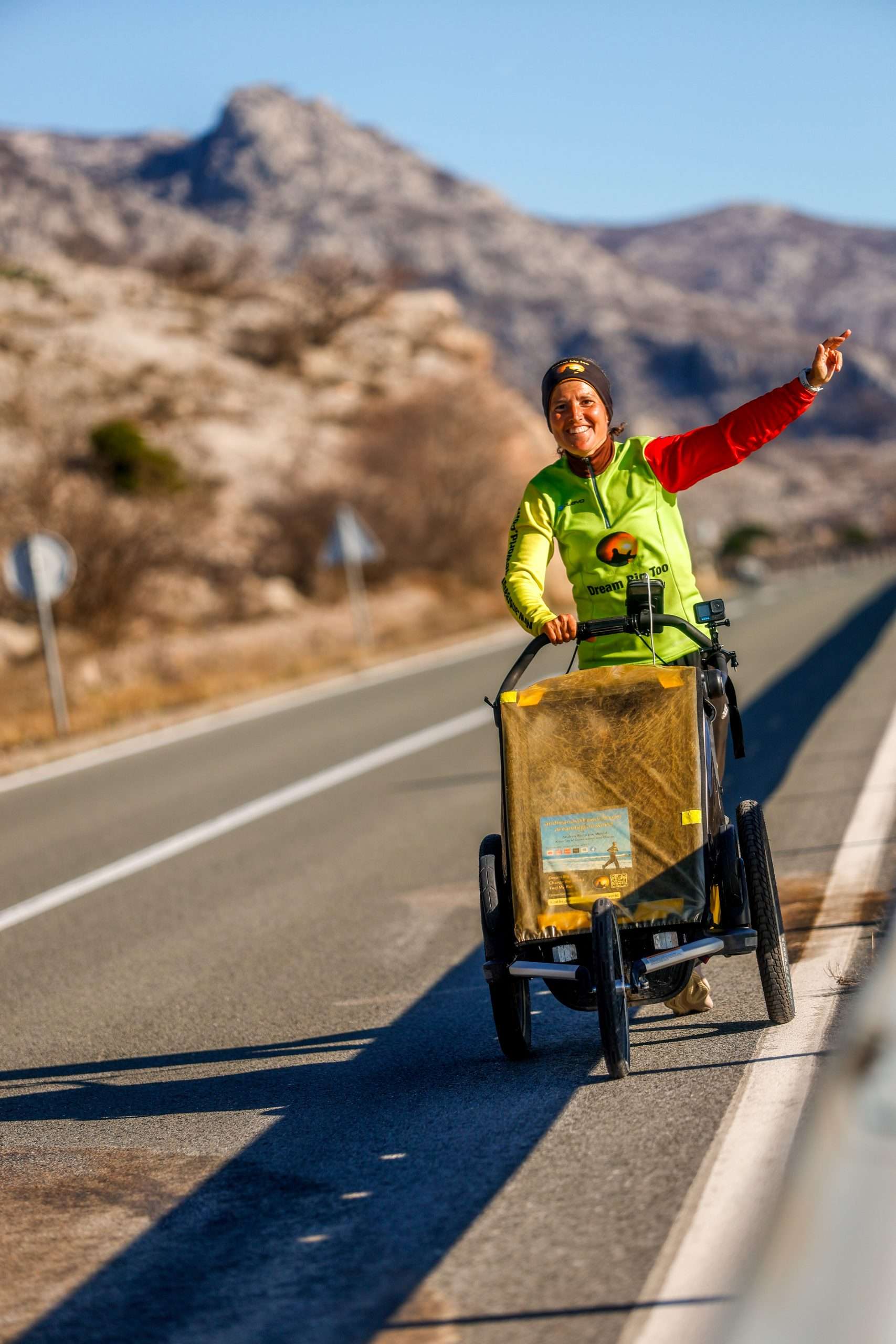
Andrea completes a run around the world at St Christopher’s Hospice

A photograph of Andrea running whilst pushing a wagon in front of mountains. Andrea is wearing sunglasses and a cap, plus running gear.

Andrea, a 45-year-old nurse from Zurich, Switzerland, has spent the last 18 months running around the world. Her extraordinary 554-day journey concluded at St Christopher’s Hospice in June 2026.

Reflecting on her experience, Andrea describes the run as “a great journey to learn about myself, the world, and the kindness of people all around the world.”

Andrea will have completed her World Run according to the criteria established by the World Runners Association (WRA). Following ratification, she is expected to become the eighth person, third woman, and second-fastest person overall to have officially run around the world under WRA rules.

A photograph of Andrea in front of mountains. Andrea is wearing sunglasses and a cap, plus running gear.

Andrea grew up in Zurich and began her working life in an unconventional way, completing a four-year apprenticeship as a car mechanic in the mid-1990s. After seven years in the trade, she travelled extensively, spending long periods in New Zealand and on the west coast of the United States before eventually returning to Switzerland.

In 2017, she retrained as a nurse and began working on an oncology ward, administering chemotherapy and blood transfusions. She says she was drawn to the emotional depth of nursing and the opportunity to connect with patients during significant moments in their lives.

“I love people, the work, and the existential conversations with my patients,” she says. “It feels meaningful and very rewarding.”

Her global run began at St Christopher’s Hospice on 21 December 2024. On a quiet winter morning shortly before 6 a.m., she set off from the hospice and ran to Land’s End before continuing westward around the globe.

Her route has taken her through Argentina, Chile, the United States, New Zealand, Australia, Japan, South Korea, India, and Europe. After running from Istanbul, Turkey, to La Coruña, Spain, she flew back to Croatia and continued through Croatia, Slovenia, Austria, Germany, Switzerland, France, and finally back to the United Kingdom.

Throughout the journey, Andrea has relied largely on her own savings, supplemented by occasional donations and the kindness of strangers who have offered food, accommodation, and support along the way.

“People have been so generous,” she says.

Rather than focusing on fundraising, Andrea chose to use her run to raise awareness of palliative care, hospice care, and suicide prevention. She hopes her journey encourages people to speak more openly about death and dying before such conversations become urgent.

“I’m not a natural fundraiser,” she says. “But I would love for people to talk about death and dying before these issues become urgent in their own lives.”

Her decision to start and finish at St Christopher’s Hospice reflects a long-standing admiration for hospice and palliative care. She speaks warmly about several people who have inspired her, including Dame Cicely Saunders, Lotti Latrous, and Rosie Swale Pope.

“Hospice work has always touched me,” she says. “It’s about dignity, presence, compassion, and love. Ending my run at St Christopher’s feels right.”

A photograph of Andrea running in front of the sea. Andrea is wearing sunglasses and a cap, plus running gear.

After finishing her incredible journey, Andrea plans to spend a few days in the city with family, friends, and supporters before returning home to Switzerland.

Looking ahead, Andrea hopes to write a book about her experiences and continue sharing lessons from the journey through talks, events, and conversations about resilience, human connection, palliative and hospice care, and what it means to create your own path.

www.andrearunstheworld.com

“We need more volunteers because there’s a need out there.”

St Christopher's C Icon White
A photograph of Maureen. Maureen has dark brown hair in a bob and is wearing a black and white patterned top. She's sitting in a chair in the cafe at St Christopher's hospice, looking into the camera and smiling.

This Volunteers’ Week, we speak to Maureen, aged 65 years old, who’s been volunteering with St Christopher’s since 2021.

Maureen has always been local to St Christopher’s, but currently lives in Thornton Heath in Surrey. After making a decision to go back to university to change career and retrain as a social worker, Maureen started volunteering in the wards at St Christopher’s. She’s now based at the St Christopher’s Bereavement Help Point in Croydon Library.

Maureen’s focus is simple: creating a space where people feel able to come together and talk about loss in their own way.

The Bereavement Help Point at Croydon Library is weekly and Maureen volunteers there on a monthly basis to support people who join those meetings. Our Bereavement Help Points are run by trained volunteers and are designed to bring people together who are experiencing grief and bereavement

Maureen says, “I like to think that my role is just to be there… to support them and to allow them to talk,” She adds: “It’s about them speaking more than I speak.”

“People have said that they love the space because there is no other space like here. And they know that they can come and sit and cry and talk about the person they’ve loved or just to give to support to other people that I’ve come into the group. So it’s a worthwhile thing to have available to people.”

The group welcomes anyone who has experienced bereavement, and people attend as and when they need. “They use the group as they need to, they know that the support system is there,” Maureen says. “You can come for the two hours or you can just come as you want, or just to listen.”

A photograph of Maureen Mitchell. Mauren has should length dark hair in a bob and is sitting in a blue armchair in front of a bookshelf. Maureen is wearing a black and white patterned top and is smiling.

What makes the space powerful is its peer-to-peer nature. “A peer support group is for people to talk and share their stories. Sometimes its about listening to someone else, they may have gone along the same journeys,” she says. Attendees value the openness and understanding, often describing it as somewhere they can speak freely: “They know that they can come and sit and cry and talk about the person they’ve loved.”

For Maureen, volunteering is about connection rather than recognition. “I suppose I’m doing this because it’s something that I’m interested in. I believe in what I’m doing,” she reflects. Those small, human moments matter most to her, like sitting with someone and simply reading a poem. “It was just so lovely that you sat and you didn’t ask many questions,” she recalls them saying. “You just read the poem to me.”

She believes volunteers play a vital role in the work of St Christopher’s, both within the hospice and out in the community. “St Christopher’s has a lot of volunteers and they need a lot of volunteers, it helps them be out there among the community,” she says.

Her message for Volunteers’ Week is clear: “Go ahead and do it, we need more volunteers because there’s a need out there.”

“It just gives me a sense of peace, tranquillity and calm.”

A photograph of Melissa's beautiful garden. There is a brick patio that leads to a seating area, and beyond that, grass. There are shrubs and bushes all around, and some purple flowers along the brick patio.

Melissa hopes that visitors to her delightful Dulwich garden will find themselves transported to her native Australia.

Come Sunday 17 May 2026 there may well be a lengthy queue of people eager to see and experience the garden designed by Ula Maria, winner of the prestigious Best in Show award at the 2024 Chelsea Flower Show.

As well as bringing a bit of Melbourne to south London, City lawyer Melissa hopes those that come and support St Christopher’s Open Garden scheme enjoy the same sense of serenity she does.

“It just gives me a sense of peace, tranquillity and calm. It feels like an oasis away from the busy city life. It’s very special.

“I wanted to create an Australian style atmosphere bringing the outdoors seamlessly into the back of the house with the sense of a cascade of garden.”

Designer Ula echoes that explanation of the concept: “The aim was to create a seamless, organic transition from the house into the garden, softening the architectural elements introduced to resolve the level changes between the interior and exterior spaces. I wanted the garden to feel informal and subtle but contemporary at the same time. A space for relaxing, entertaining, exploring and simply being. 

A photograph of Melissa's beautiful garden. There is a brick patio that leads to a seating area. There is a table with charis all around, with sun shining down. There is an outdoors sofa in the background.

To complete that look and feel, the house had to be dropped down a few feet. Only completed in 2023, the garden is still quite young but already has a number of features Melissa hopes visitors will enjoy.

“There was already an apple tree at the back of the garden and Ula has created a woodland feel with a little meadow next to it. She’s brilliantly created a kind of terracing, with different levels which feels super organic with higgledy piggledy steps and metal clad beds that blend in.”

Ula says she was inspired by the close proximity of Dulwich Park and wanted to work with the existing informal feel.

She adds: “The planting design builds on the garden’s ethereal, orchard-like atmosphere, enriched with edible greenery and fruit trees such as pears and apples. The meadow running along the garden’s central axis invites wildlife into this urban space, enhancing its sense of natural calm.”

Given the youth of the garden, Melissa isn’t 100% sure what visitors can expect to be in bloom in May.

With the help of her two children aged 13 and 10, friends and volunteers from St Christopher’s, Melissa will definitely provide a warm welcome and hopes to lay on refreshments too.

Speaking of volunteers, it was a visit from the St Christopher’s Open Garden dynamic duo, Myra and Jo, that persuaded Melissa to participate in the scheme that gives people a chance to enjoy floral delights across south London between April and September; while raising valuable funds for St Christopher’s Hospice.

“My next-door neighbour recommended me to Myra and when she and Jo came and had coffee with me I just couldn’t refuse. They’re beautiful people and I know St Christopher’s because I’ve donated previously and there’s the shop close by in Dulwich.

“I haven’t got a specific personal connection to St Christopher’s, but I did lose my mother to cancer aged just 67 and caring for people at the end of life is such an important issue so I felt very supportive.

“Additionally, I grew up in a very community-oriented family. As children we’d deliver books for the church and I’d like my kids to have an opportunity to do something positive in the community.”

A photograph of Melissa's beautiful garden. There is lush green grass and many shrubs and bushes.

While Melissa admits to very limited horticultural knowledge, she certainly enjoys the garden and sees that only growing as she ages.

“I love sitting on the sofa out there watching the birds and the bees and even in the winter we’ll sit outside with the wood burner and enjoy the peace. Then when I retire I think I’ll become obsessed with gardening.”

Bereaved mum of two, Astrid, runs the London Marathon and raises over £22,000

St Christopher's C Icon White

For novice runner Astrid Dolan the notorious London Marathon ‘wall’ holds few fears as she knows the pain she’s endured in the year or so since her husband Theo died will dwarf anything she suffers as she strides on towards the 26.2-mile finish line, cheered on by her two young daughters.

So determined is Astrid, to recreate the happy place the London Marathon held for the whole family, that she’s going all out not only to complete it, but to experience it from Theo’s viewpoint and raise money for St Christopher’s who have provided bereavement support to her and one of her daughters, five-year-old Mollie.

“Theo ran every day and never took a break,” she says. “The London Marathon was his favourite day of the year, and it became a special day for the family.

“When I say he adored the London Marathon, I mean he was obsessed – he may as well have been doing PR for them, constantly encouraging others to enter! He was absolutely infectious, running with joy and determination, somehow pulling off incredible times. His dream for 2025 was to run a sub-3-hour marathon.”

Tragically, Theo died in January 2025 and when marathon day came around three months later, Astrid says it was one of her darkest days.

“With Theo, the Marathon was such a positive day. The girls had signs they’d proudly painted, he would run amazingly and it was just so happy.

“Last year I found the day so triggering. It was the worst day since the funeral and it just felt like it represented all the happiness we’d lost. I sat in the house with his ashes on my lap and bawled.”

Demonstrating the same resoluteness that she’d shown from day one, Astrid quickly turned what was a heartbreaking day into a positive one – by entering the ballot for London Marathon 2026.

“I want my kids to be able to enjoy it again, to be able to paint those signs and have to someone to cheer for. It will always be painful but hopefully it’ll change my perspective so that I can enjoy it again too.”

A photograph of Astrid, her late husband Theo and their two daughters. Theo has just completed the London Marathon and is wearing a medal, with his arm around Astrid. Astrid is holding the handles of two prams with their daughters in.

“From two weeks after Theo died, St Christopher’s has always been there for us. Through this unbearable journey, they have been our anchor.

“I was so desperate to do everything I could for the girls and so the first time I called Emma in the Candle Child Bereavement team was to ask for her advice about whether they should go to the funeral. She reassured me that my gut instinct to include them was the right thing to do. From the very start she was so caring and understanding.”

Such is the demand for the Candle service that it was June before Mollie had the first of her six weekly therapy sessions with Emma, but Astrid says Emma was always at the end of the phone or an email.

“Emma made the sessions so fun and she was so gentle. They did art, looked at photos and played with toys while talking and remembering Mollie’s dad. She has always been there for us.”

For Astrid, even the small acts of kindness really resonated with her.

“All the staff are so kind and welcoming, they really get how intensely overworked a widow is. A coffee and biscuit – those tiny gestures of care make such a difference. On one of my first visits to St Christopher’s, I was really upset and properly loud crying. People came and comforted me gave me something to eat, a coffee and a hug. The whole experience was so empathetic and kind.”

Astrid has attended monthly group sessions with other parents of bereaved children and appreciates sharing the highs and lows with other people who’ve shared a similar experience of what she describes as ‘such a lonely journey’.

But it’s the professional bereavement support for Mollie and the knowledge that it will be there for Elodie when she’s old enough, and for herself when it’s the right time, that really means so much to Astrid. This drives her on as she strives to ensure she completes the marathon for St Christopher’s.

“Emma really has given her heart to us as a family and that is so rare and so lovely when you’ve gone through this kind of loss.”

The family have also taken strength from the remembering events they’ve attended with members of their extended family – tying a ribbon on the tree in the summer and lighting a candle for Theo at Christmas.

Astrid views her relationship with St Christopher’s as instrumental in her family’s journey towards turning their grief into something meaningful. Now she’s looking to her participation in the Marathon to play its part too and has been documenting her journey on social media (Instagram: @astriddolan).

“For us, the Marathon has to return to what it was for Theo – a symbol of resilience, strength, and the courage to keep moving forward.”

Meet Sasha, St Christopher’s Hospice Doula

Sasha has shoulder length dark hair with a fringe. She's wearing glasses and is sitting at a table, smiling at the camera with her hands clasped in front of her.

When Sasha Primakova reflects on her journey from the world of research in Moscow to the quiet corridors of St Christopher’s, she describes it as a total transformation.

After 20 years leading a successful qualitative research department in Russia, a sudden and forced relocation due to the war in Ukraine became the catalyst for Sasha to pursue a calling she had felt for years: exploring the topic of death and dying.

Having witnessed a funeral culture in her home country that she describes as “inhumane” and “impersonal,” Sasha became determined to learn how death could be handled with more dignity and presence and trained as a ‘doula’.

While the term ‘doula’ is often associated with birth, an end-of-life, hospice or death doula supports the other end of the life cycle. They are a non-medical professional trained to provide holistic support – emotional, physical, spiritual, and practical – to individuals approaching death and their families. Their work is highly personalised and varies based on the needs of the person, but it mostly includes emotional and spiritual support, practical admin and logistics assistance, advocacy and education, and after death care.

Throughout the two years she lived in Georgia after leaving Russia, Sasha completed international training as an end-of-life doula and flew several times to London, for placements at St Christopher’s. “I was absolutely stunned”, she says, “to see nurses who are so medically knowledgeable, but at the same time, the way they spoke to people was perfect. There was not only respect, but true compassion.”

She was particularly impacted by seeing the staff’s genuine sadness when discussing a patient who had died, proving that even in an environment where death is expected, every individual life is deeply valued.

Sasha Primakova, St Christopher's Hospice Doula, sitting at a table with her hands clasped in front of her. Sasha has shoulder length dark hair and is wearing glasses. She's smiling whilst looking at the camera.

The most common term for Sasha’s role is a death doula, however the term Hospice Doula reflects her integration with the medical team more clearly.

“I’m not here to replace a doctor or a nurse, but to be the extra pair of eyes that a busy clinical team might not always have,” she says.

“In some cases, it’s probably important for patients and families that I’m not medical,” she says.

Sasha usually describes her role to her colleagues in a simple way: “If you’re leaving the patient and your heart is aching, and you would want someone to come and help, just refer them to me and I’ll see what I can do.”

Doulas often work as volunteers or as a paid-for service so what makes Sasha’s role unique is that she is employed by St Christopher’s, making her the first ever contracted doula in a hospice in the UK. Initially commissioned by the borough of Croydon for a project to tackle inequalities, her role has expanded since January 2026 to St Christopher’s patients living in Southwark, Lewisham, and Lambeth.

But what does a doula actually do? For Sasha, no two days are the same. Her role is defined by whatever the patient needs in that exact moment to feel more at peace.

“It could be anything,” Sasha says. “Fixing their phone or bringing them an ice cream or sitting with them while they’re too anxious to sleep… or I can help to navigate really challenging discussions with their family.”

Reflecting on recent successes, she highlights her ability to bridge emotional gaps and provide steady support, even during crises.

She recently helped a couple confront a terminal diagnosis together, guiding them to communicate openly rather than withdrawing in an effort to protect one another. Sasha also shared how she provided immediate support to a young girl following the sudden death of her mother; she stayed with her until other family members arrived.

For Sasha, success isn’t measured in big gestures, but in the subtle shift of a patient’s experience.

Sasha mentions four aspects she tries to bring to her work to impact people positively. The first is to make the process more meaningful: facilitating conversations, listening to people’s stories and planning parts of their legacy.

Secondly, she wants to make the experience better, for example, by making sure someone isn’t alone during a moment of high anxiety. The third aspect is to make it more like people want it to be, supporting with tasks such as documenting someone’s final wishes. Lastly, Sasha wants to make sure the wider team feels she has been helpful. “Every nurse on my team has now referred a patient to me”, she says, proving that a doula is not just a luxury, but a vital part of the modern hospice ecosystem.

“Dying is a very dignifying thing”, she says, “And our main mission as people who work with palliative patients is to show that the moment you get your palliative diagnosis, it doesn’t mean that you’re dying.”

If we use the comparison of a diagnosis or prognosis with the beginning of life, then we all know that the moment a person gets two stripes on a pregnancy test just means they are pregnant, not that they’re giving birth.

“There is time until it happens”, Sasha says, “and that time can be so intense and so meaningful.”

Visually impaired carers are the latest cohort to receive palliative care training in Bangladesh

The Institute of Palliative Care Bangladesh (IPC-B), under the Palliative Care Society of Bangladesh (PCSB), successfully conducted the first 20-hour training program for visually impaired carers from 7–9 November 2025.

A total of 18 participants, including 14 visually impaired trainees, completed the 20-hour training. The course used specially adapted Braille training materials to ensure accessibility.

A photo of 3 individuals sitting at a table, using braille to read books.

The training covered key aspects of palliative care including communication, symptom support, emotional care and community participation. Pre- and post-training assessments showed clear improvement in participants’ knowledge and confidence, and the programme received an overall satisfaction score of 8.8/10, with all participants expressing interest in advanced training.

The programme concluded with a certificate ceremony and a cultural event jointly organized by trainees and students of the host school.

This pilot initiative demonstrates the strong potential of visually impaired individuals to contribute meaningfully to inclusive, community-based palliative care in Bangladesh.

The Palliative Nurses Society of Kenya (PANUSK)

Sylvester Wambua (Kenya, Africa)


It’s possibly the greatest endorsement of the Palliative Nurses Society of Kenya (PANUSK) that it will be hosting a meeting shortly to discuss whether to extend membership to nurses working in other specialisms.

In the three years since Sylvester Wambua and fellow GPNN member Stella Mwari Rithara and Gladys Mukosi started PANUSK, it has grown to include 150 members from across Kenya and has become a national movement shaping the future of the country’s palliative care.


Sylvester says the aim was to establish a network to connect palliative nurses and to advance the specialism. Workshops, webinars and professional education are just some of the ways in which the society is strengthening nurses’ capacity while also advocating for the integration of palliative care into mainstream healthcare.

“It is nurses who are driving palliative care in Kenya. We are specially trained in handling sensitive issues and it is the compassion of nurses that helps us champion the patient when they need us most.” Sylvester says he has noticed a huge difference in the palliative care landscape in Kenya in the nine years since he started working in the field. But gaps in service remain in parts of Kenya and Sylvester hopes that the growth of PANUSK will help plug those gaps.

“With the help of mentorship programmes, if we can make sure that at least one person in every hospital we can transform patient care across the system.”

Certainly, word is spreading fast in Kenya and Sylvester and his colleagues running PANUSK now face a major decision; whether to respond to demand from nurses working in other specialisms to join the society. A decision will be taken at a meeting next month. Sylvester is keen to credit his membership of GPNN for some of PANUSK’s success.

“Everyone in GPNN has one common goal and through the network we are able to get expertise from different parts of the world, to see the innovations that work in some places and not in others. So, then we’re able to think global and apply local, taking learnings from our international peers and adapting them to the Kenyan context. In practice, Silvester has taken learnings from GPNN colleagues in Cameroon, Bangladesh, Lebanon and Abu Dhabi.

“That’s why we’re trying to mobilise more people from PANUSK to join GPNN so they can open their eyes to see what it’s like practising outside Kenya as well.”


With a strong start to its short life, Silvester has ambitious plans for the society in the next decade.“Capacity building is one of the main goals – to ensure we have a workforce that can handle the burden of people with palliative care needs and to see that integrated in the community. “I’d also like to see some of our nurses in policy making positions as well as teaching and mentoring so they can help the next nurses coming through to be leaders.”

The list of aims and objectives doesn’t stop there. Sylvester would like to see a further extension of compassionate communities supported by high school, college and university students, an established home care service and a functioning tele-medicine service too.

Challenges and barriers do remain though, Sylvester acknowledges. The sheer size of Kenya makes in-person meetings difficult for those nurses working in some outlying areas. There remains, he adds, a less than universal acceptance of the importance of palliative care and limited opportunities for nurses to return to education.
“Inch by inch we are getting there,” Sylvester says pragmatically. “We’ve now had a palliative care policy in Kenya for five years and we as nurses have revised the national guidelines.”

With a clear vision, growing membership, and a deep commitment to compassionate care, PANUSK is helping shape a future where palliative care is accessible, integrated and patient-centred across Kenya.

Sylvester and his colleagues are always interested in collaboration and you can contact them via panusk@gmail.com.